A Data Reconciliation Platform For Public Health Reporting
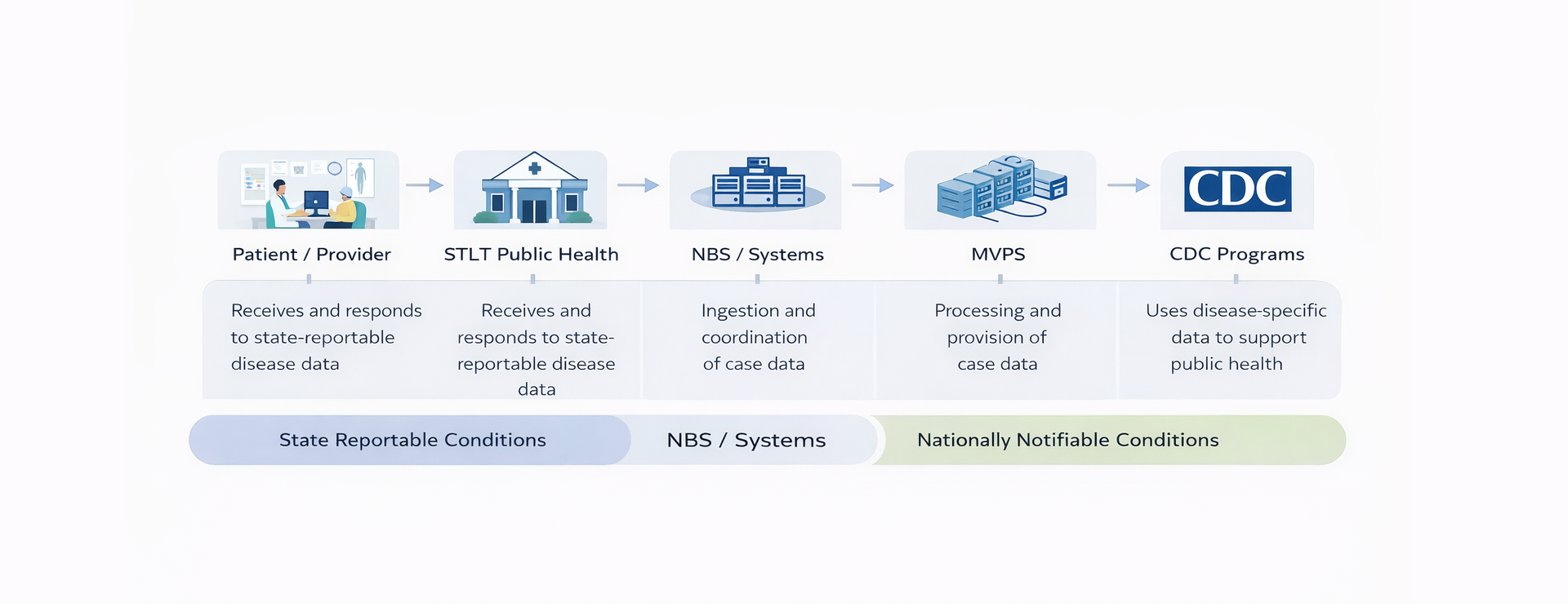
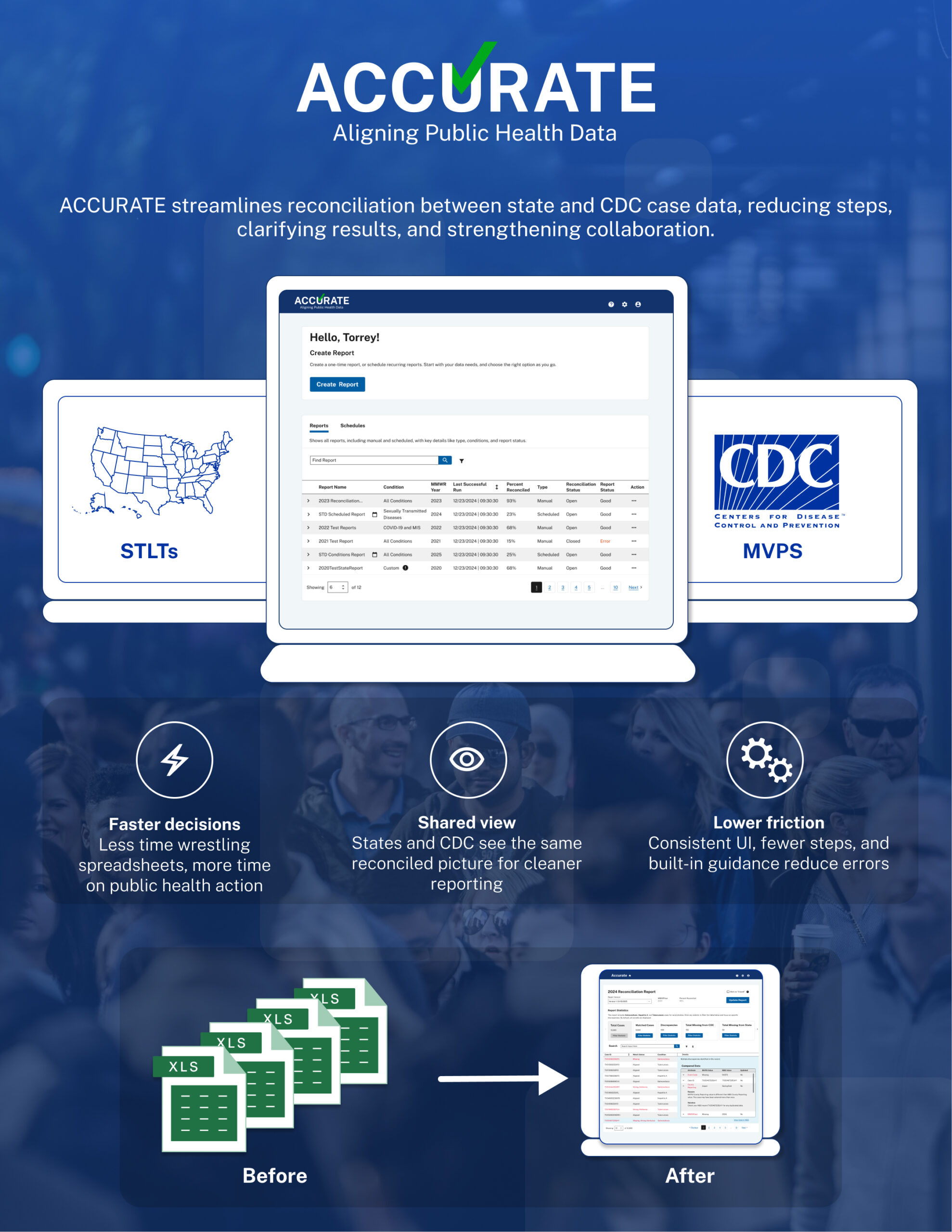
Public health reporting depends on accurate data flowing between state, tribal, local, and territorial (STLT) systems and the CDC. When discrepancies occur, epidemiologists must manually compare records across multiple systems, often relying on spreadsheets, inconsistent workflows, and institutional knowledge to identify issues.
ACCURATE was created to transform this process from a fragmented, manual effort into a structured reconciliation platform. Working with the CDC and participating states, I led UX from discovery through MVP, helping define the product vision, reconciliation workflow, and user experience for a complex public health ecosystem.
Role
Senior UX / Service Designer
Scope
Discovery → MVP
Environment
CDC, public health data systems
Product Walkthrough
A short walkthrough of the core reconciliation experience, including report setup, data comparison, and discrepancy review.
This walkthrough highlights the end-to-end workflow designed to help users move from raw data ingestion to identifying and resolving discrepancies across systems.
Why This Project Mattered
Public health teams are responsible for reconciling case data between state systems and the CDC. This process is critical for accurate reporting, but the underlying workflows are fragmented, inconsistent, and often manual.
Differences in how data is structured, grouped, and reported across systems create significant friction. Users must spend time identifying mismatches, validating records, and resolving discrepancies without a clear or unified workflow.
ACCURATE was created to bring structure and clarity to this process, enabling users to more efficiently understand and act on differences in their data.
The Challenge
This was not a traditional UI problem. The challenge was defining a product within a complex and ambiguous ecosystem. Unlike a traditional enterprise application, reconciliation required aligning. This was hard.
Key complexities included:
• Multiple data sources with inconsistent structures
• Variation in how conditions are grouped and reported
• High reliance on manual reconciliation workflows
• The need to support both flexibility and repeatability
• Constraints around PHI and data visibility
The work required translating a fragmented system into a coherent experience while aligning stakeholders across product, engineering, and public health domains. The challenge was not simply comparing data. It was designing a repeatable operational process that could work across a diverse public health ecosystem.
My Role
I led UX across the full lifecycle of the product, from early discovery through MVP definition and design.
My responsibilities included:
• Leading discovery and synthesizing findings across stakeholders
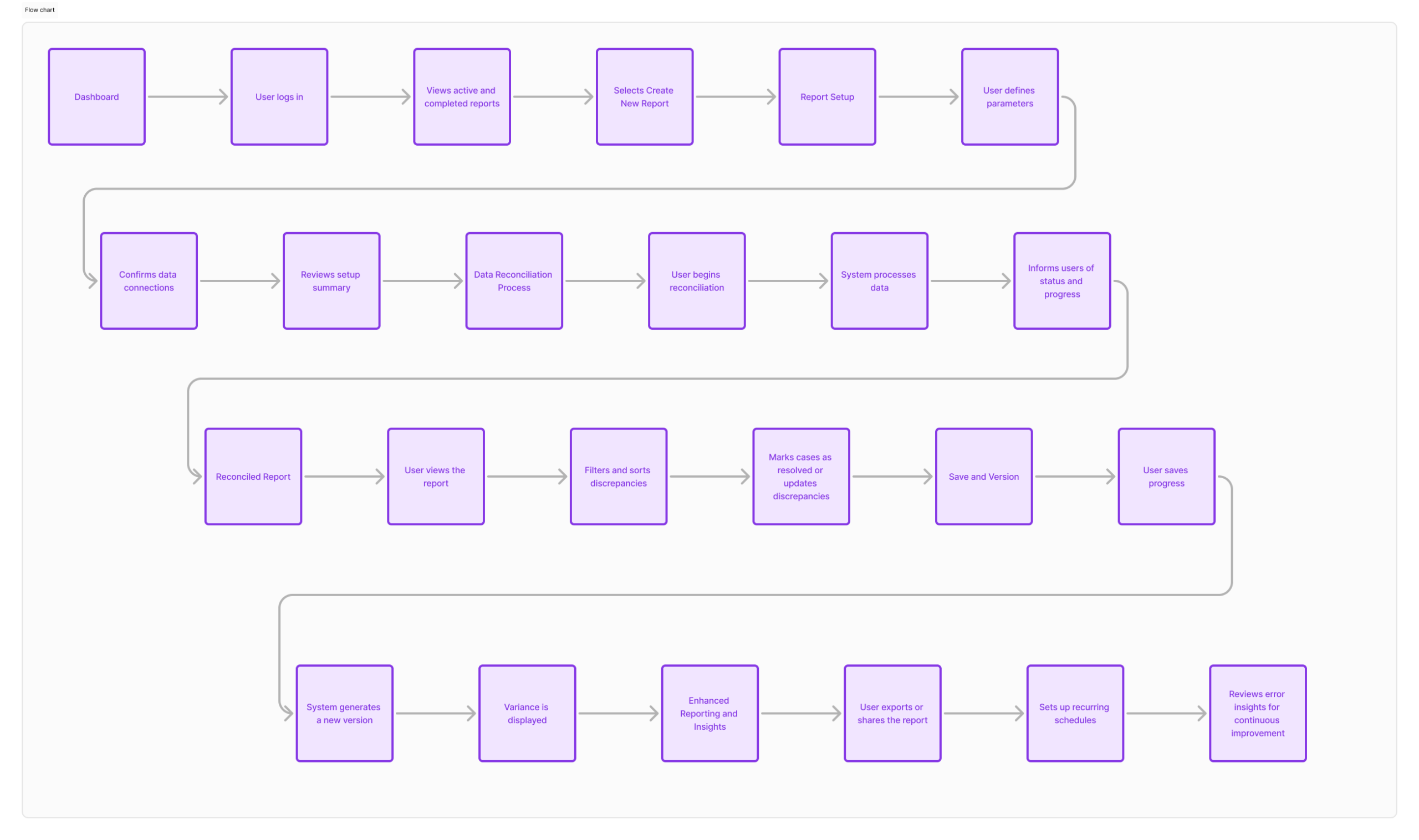
• Defining end-to-end workflows for reconciliation
• Structuring the product experience and interaction model
• Designing and prototyping core features and flows
• Collaborating closely with product, engineering, and CDC stakeholders
• Helping align the team around a clear, actionable product direction
Approach
Discovery
Conducted stakeholder interviews and analyzed existing workflows to understand how reconciliation was performed across systems.
Synthesized findings into key pain points, focusing on inconsistencies in data structure, workflow fragmentation, and lack of clarity in identifying discrepancies.
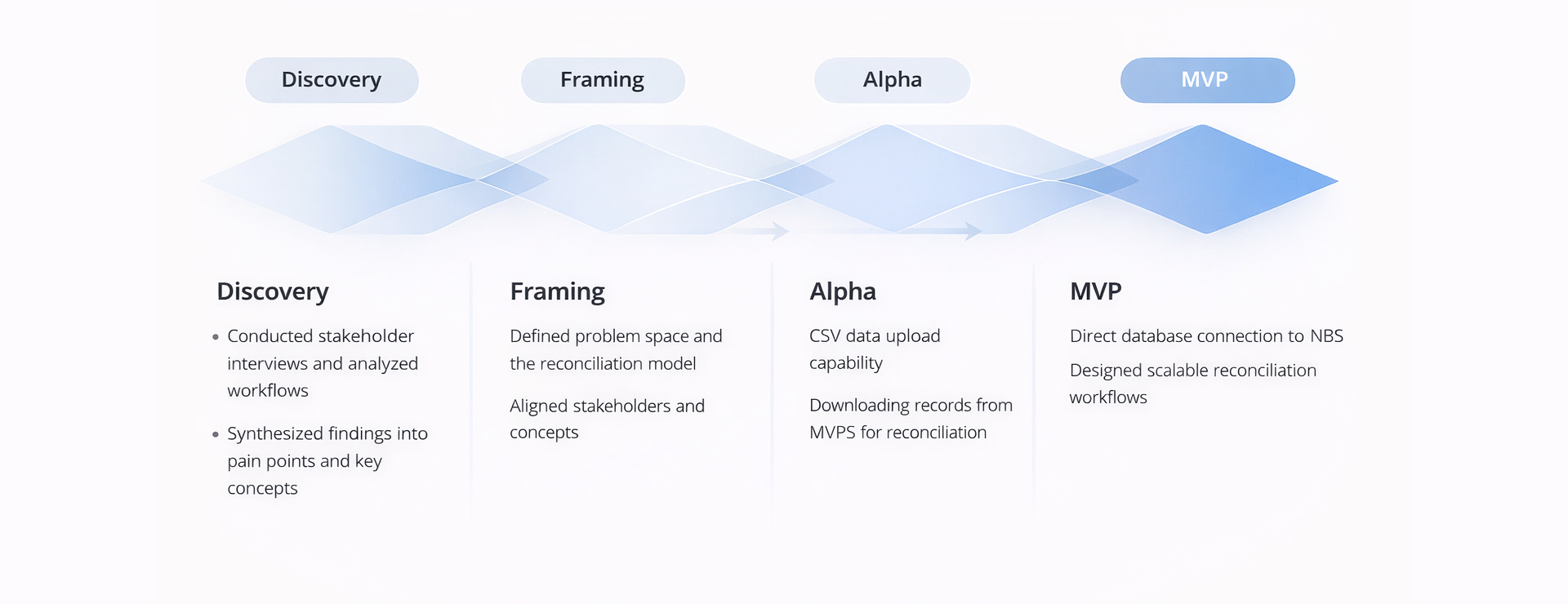
Framing
Defined the core problem space and established a structured approach to reconciliation.
Aligned stakeholders around key concepts such as:
• staged reconciliation workflow
• standardized discrepancy types
• clear separation of data views
Alpha
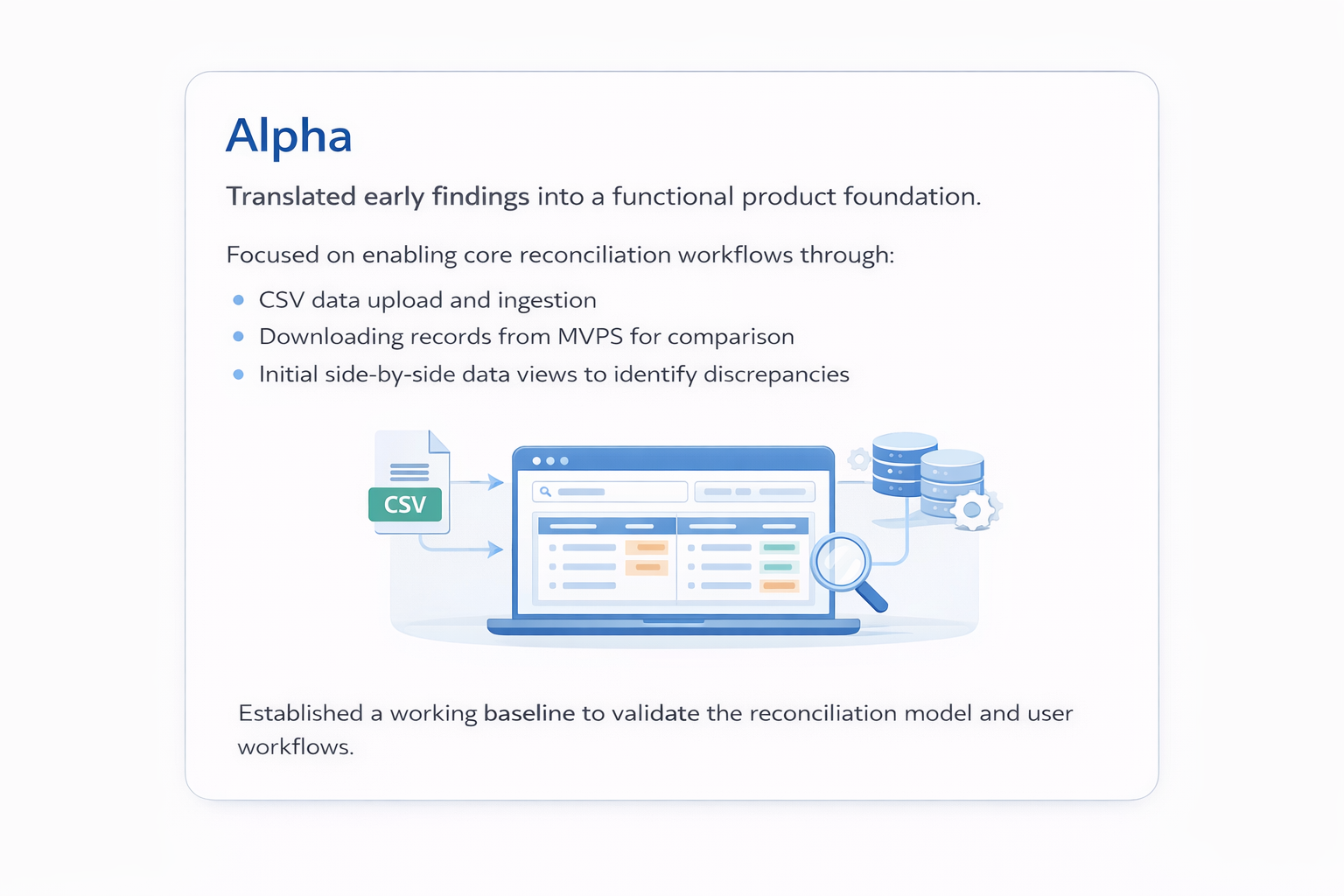
Close collaboration with CDC and STLT stakeholders was critical during Alpha to ensure the workflows reflected real-world reconciliation needs.
We worked iteratively with stakeholders to validate assumptions, review early outputs, and refine how data was ingested, compared, and interpreted. This continuous feedback loop helped mitigate risk, align on core concepts, and ensure the foundation we were building would scale effectively into MVP. State systems varied significantly in technical maturity and connectivity. Rather than delaying value while waiting for integrations, the initial experience focused on CSV-based reconciliation, allowing teams to begin identifying discrepancies immediately while future integrations were explored.
MVP
Evolved the Alpha into a scalable, production-ready solution.
Focused on:
• Direct database integration with NBS
• Structured, end-to-end reconciliation workflows
• Improved discrepancy identification and categorization
• Enhanced usability and clarity across complex data interactions
Refined the experience based on stakeholder feedback and technical constraints, simplifying interactions while preserving flexibility for real-world use.
Key Design Decisions
The complexity of reconciling public health data required more than interface design. It required structuring how the work itself happens.
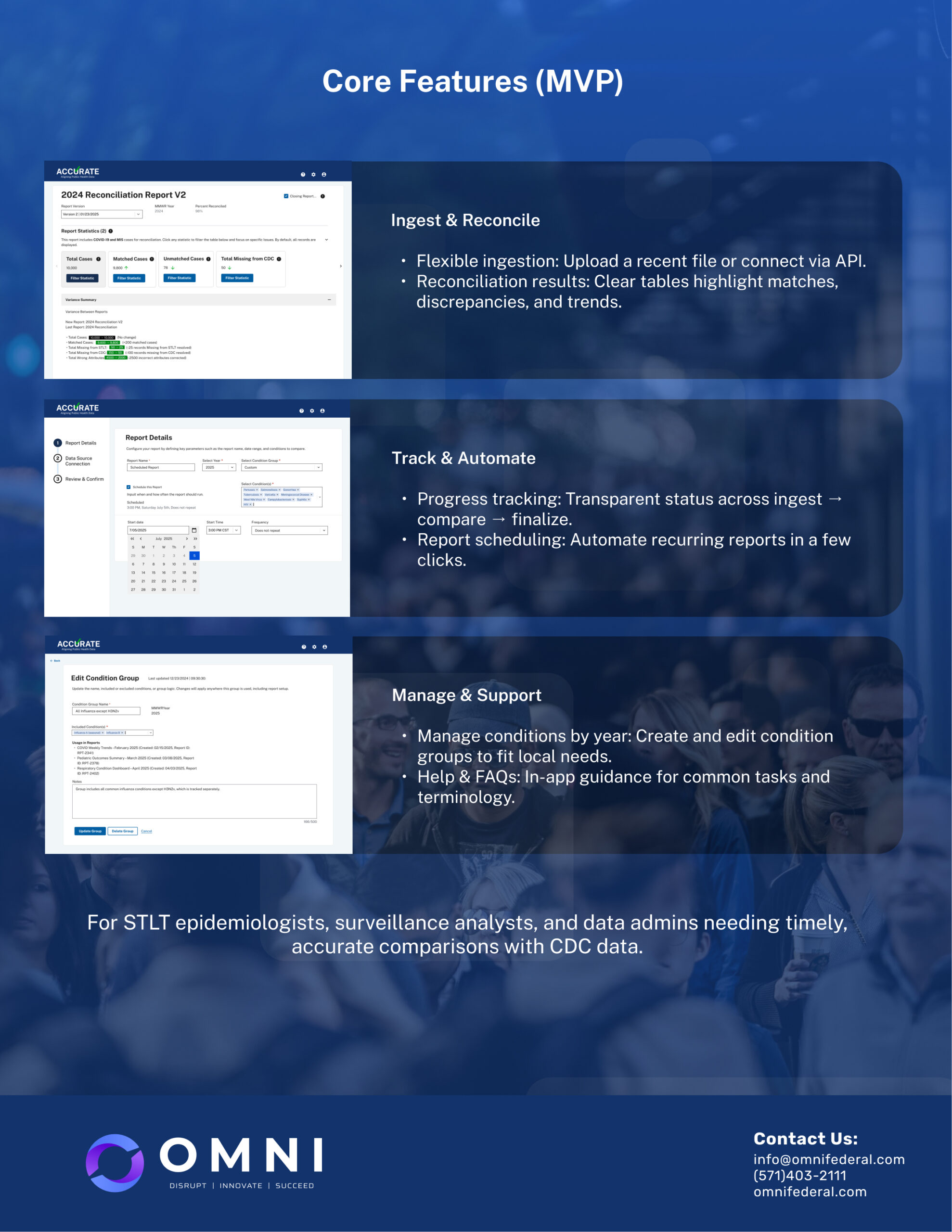
These key design decisions were driven by real world workflows, data constraints, and stakeholder input. They translate a fragmented process into a clear, repeatable system that supports both analysis and operational use.
Structured reconciliation workflow
• Designed reconciliation as a clear, staged process to guide users from data ingestion through discrepancy resolution.
• This reduced ambiguity and made complex workflows more predictable and repeatable.
Compared vs. rendered data
• Separated “compared data” (core reconciliation) from “rendered data” (supporting context).
• This allowed users to focus on discrepancies while still having access to the detail needed for troubleshooting.
Flexible but repeatable reporting
• Balanced one-time report creation with scheduling capabilities.
• Users could define a report once and reuse it, supporting both ad hoc analysis and recurring workflows.
Condition management by year
• Introduced condition management tied to reporting year, allowing users to align with how data is actually grouped and reported in practice.
PHI-aware experience
• Designed for full data visibility within active sessions while supporting limited views outside of them.
• This ensured usability without compromising data handling constraints.
Product Highlights
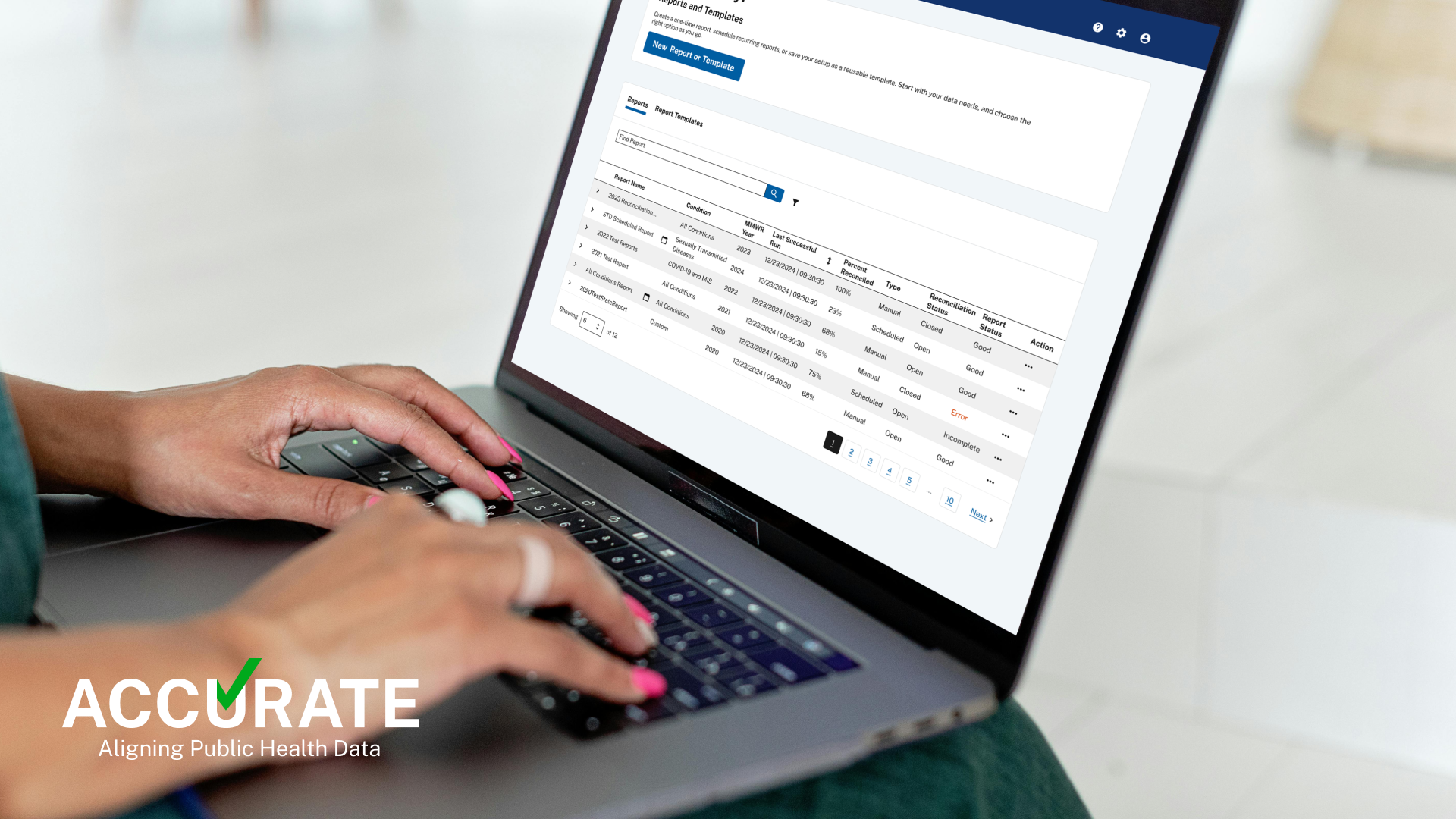
Report dashboard
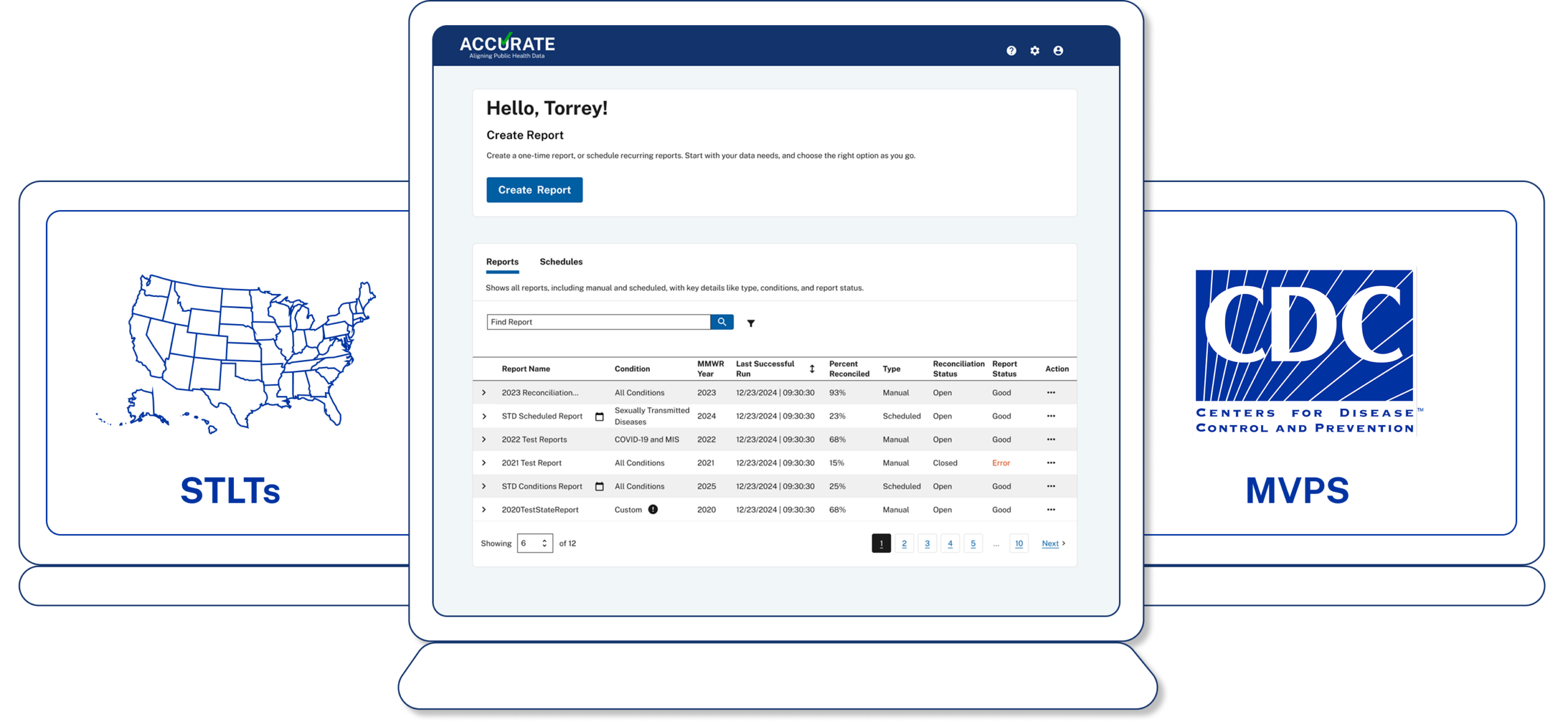
A centralized view of all reports, including scheduled and manual runs, allowing users to track status and quickly access results.
Reconciliation workflow
A structured workflow that guides users from data ingestion through comparison and resolution, reducing ambiguity and making complex reconciliation tasks more predictable.
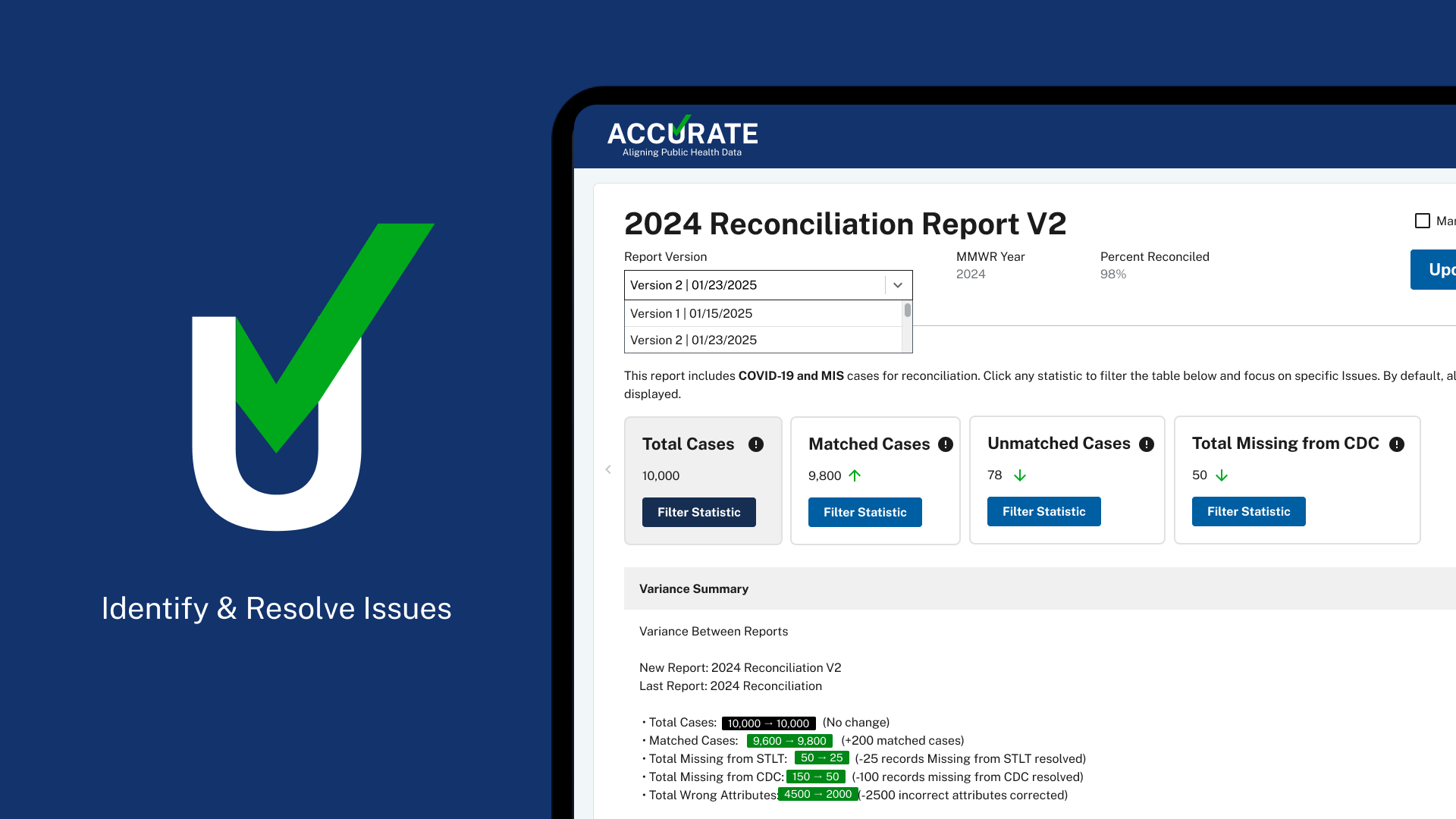
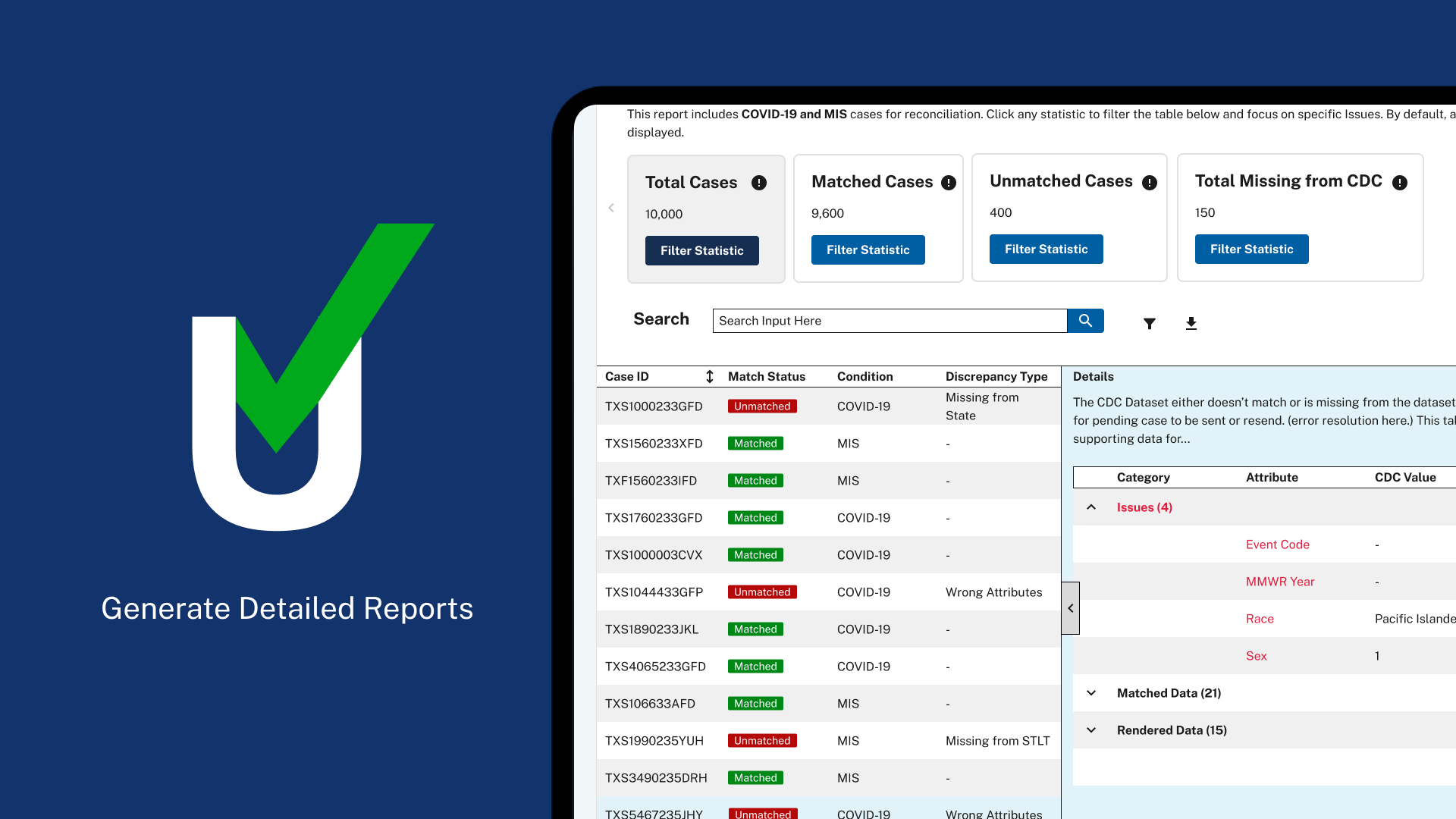
Discrepancy review
Discrepancies are surfaced and categorized in context, allowing users to quickly understand issues and focus on resolution without leaving the workflow.
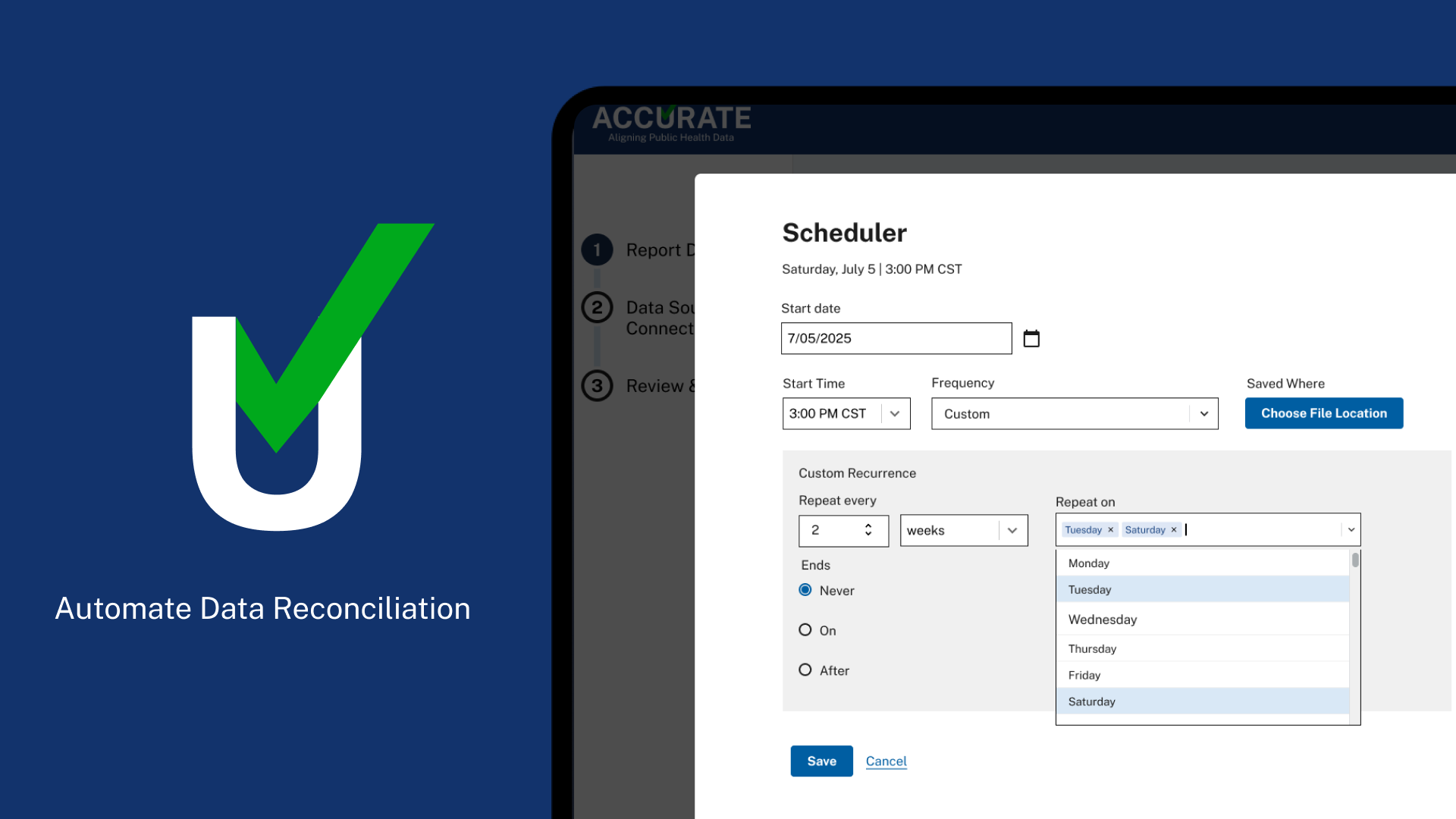
Scheduling and automation
Scheduling transforms reconciliation from a one-time task into a repeatable process, enabling teams to maintain data quality over time.
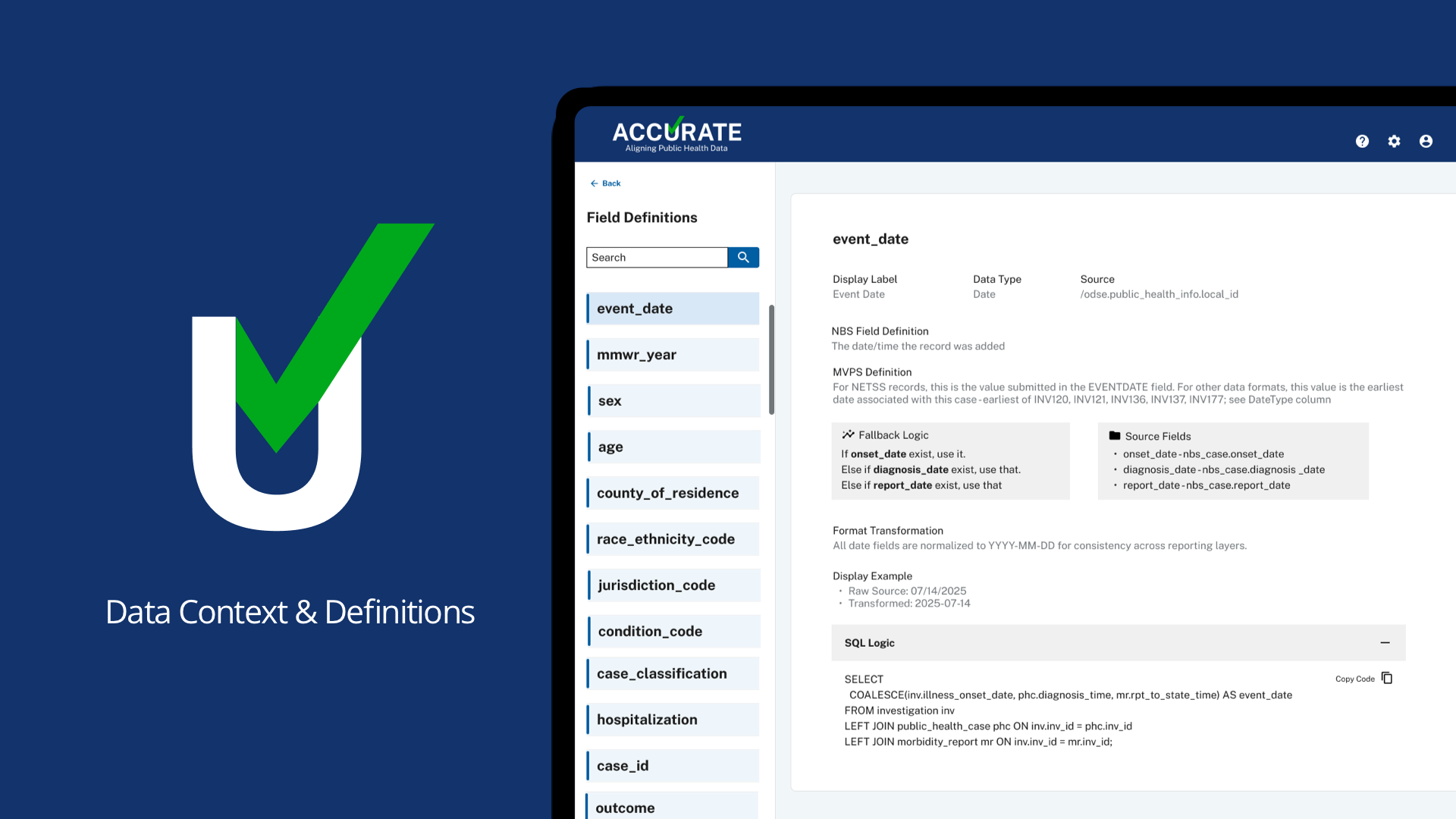
Data definition support
Integrated access to field definitions and mappings to help users understand discrepancies without leaving the workflow.
Outcome
ACCURATE established a clear and structured approach to data reconciliation within a complex public health ecosystem.
The work:
• Defined the product direction for MVP
• Translated fragmented workflows into a cohesive experience
• Improved clarity around identifying and resolving discrepancies
• Helped align stakeholders across product, engineering, and CDC teams
What Changed
The resulting MVP gave public health teams a structured way to move from data ingestion through discrepancy resolution. Instead of relying on spreadsheets and disconnected processes, users could follow a repeatable workflow that improved visibility into data quality issues and supported ongoing reconciliation efforts.
Reflection & Lessons Learned
These conditions required a more adaptive approach to design, balancing uncertainty with the need to deliver meaningful progress. Close collaboration across product, engineering, and stakeholders was critical to maintaining alignment throughout the process.
The experience also reinforced the importance of working effectively within a cross-functional team. Designing in this environment required understanding how different disciplines approach problems and adjusting communication and workflows to support shared outcomes.
The project reinforced that successful reconciliation depends as much on understanding operational workflows and stakeholder needs as it does on the underlying data. Continuous collaboration and iterative validation helped ensure the solution delivered immediate value while remaining flexible enough to evolve over time.
YOU MAY ALSO BE INTERESTED IN: