Defense
Service Design
Identity & Access
Simplifying Tactical Identity Management
Designed identity lifecycle workflows that improved account provisioning, synchronization, and access management for disconnected military environments.
Overview
What was this engagement?
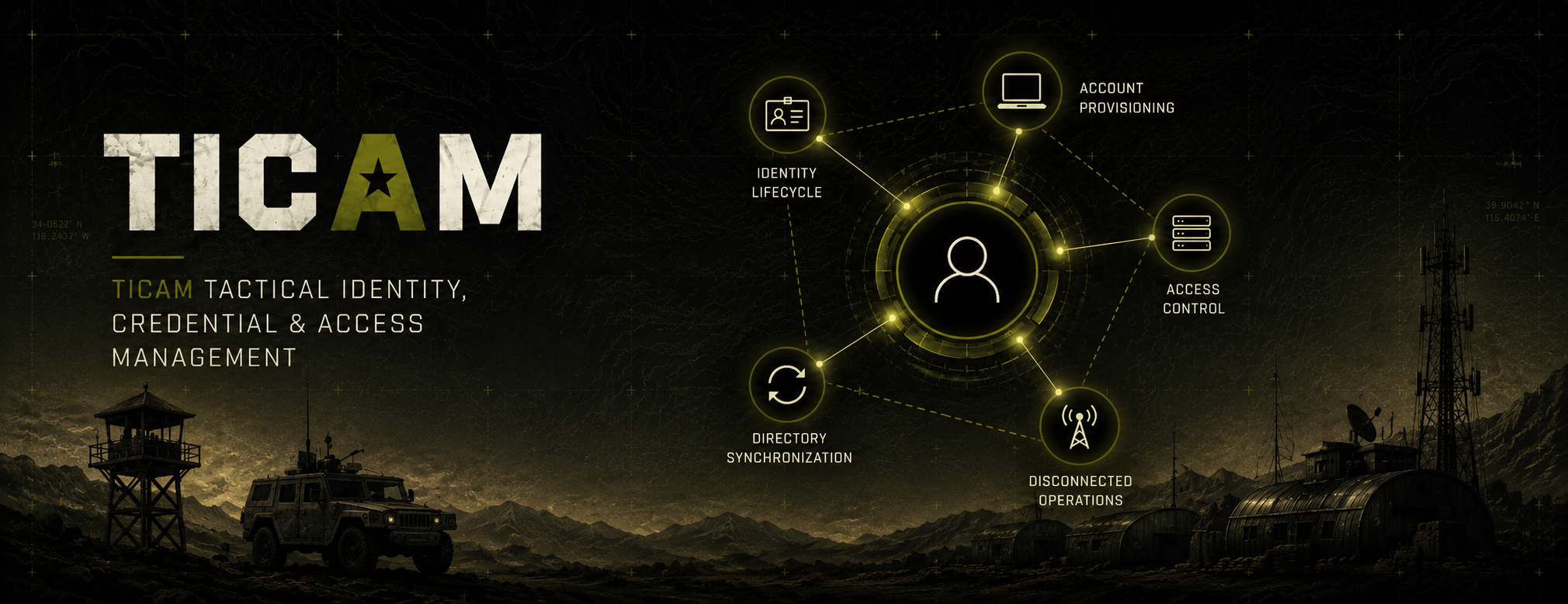
TICAM (Tactical Identity, Credential & Access Management) was a service design initiative focused on understanding how identities were created, managed, and maintained across disconnected military environments. Rather than designing a new application, our team partnered with stakeholders across the Army to uncover operational challenges, map the identity lifecycle, and identify opportunities that would guide future capabilities.
The outcome wasn’t a single product. It was a shared understanding of the current state and a strategic roadmap for improving identity management across people, processes, and systems.
I led the discovery and service design effort, partnering with Army stakeholders and cross-functional teams to understand the current state of tactical identity management and define a strategic direction for future capabilities.
Role
Senior Product & Service Designer
Duration
6 mos
Responsibilities
Discovery • Service Design • Research • Journey Mapping •
Service Blueprints • Workshop Facilitation • UX Strategy
Collaborators
Product Management • Engineers • Army SMEs •
System Administrators • Security Teams • UX
Deliverables
Discovery Findings• Identity Lifecycle Maps • Service Blueprints • Capability Model • Opportunity Framework • Prioritized Roadmap • Future Experience Vision
The Challenge
Why was this work needed?
Managing digital identities in military environments is far more complex than simply creating user accounts. A single service member may need access to dozens of applications, devices, networks, and mission systems throughout their career. Many of those systems were built independently, operated by different teams, and relied on manual processes to provision, update, or remove access.
Over time, every organization developed its own way of managing identities. The result was a patchwork of disconnected workflows, inconsistent policies, and limited visibility across the identity lifecycle. Even experienced administrators often understood only the portion of the process they managed themselves.
Before a new solution could be designed, the team first needed a shared understanding of how identities actually moved through the organization from onboarding to off boarding and where those processes were breaking down.
Discovery
How did we understand it?
Before proposing solutions, we needed to understand how identity management actually worked across tactical environments… not how documentation said it worked.
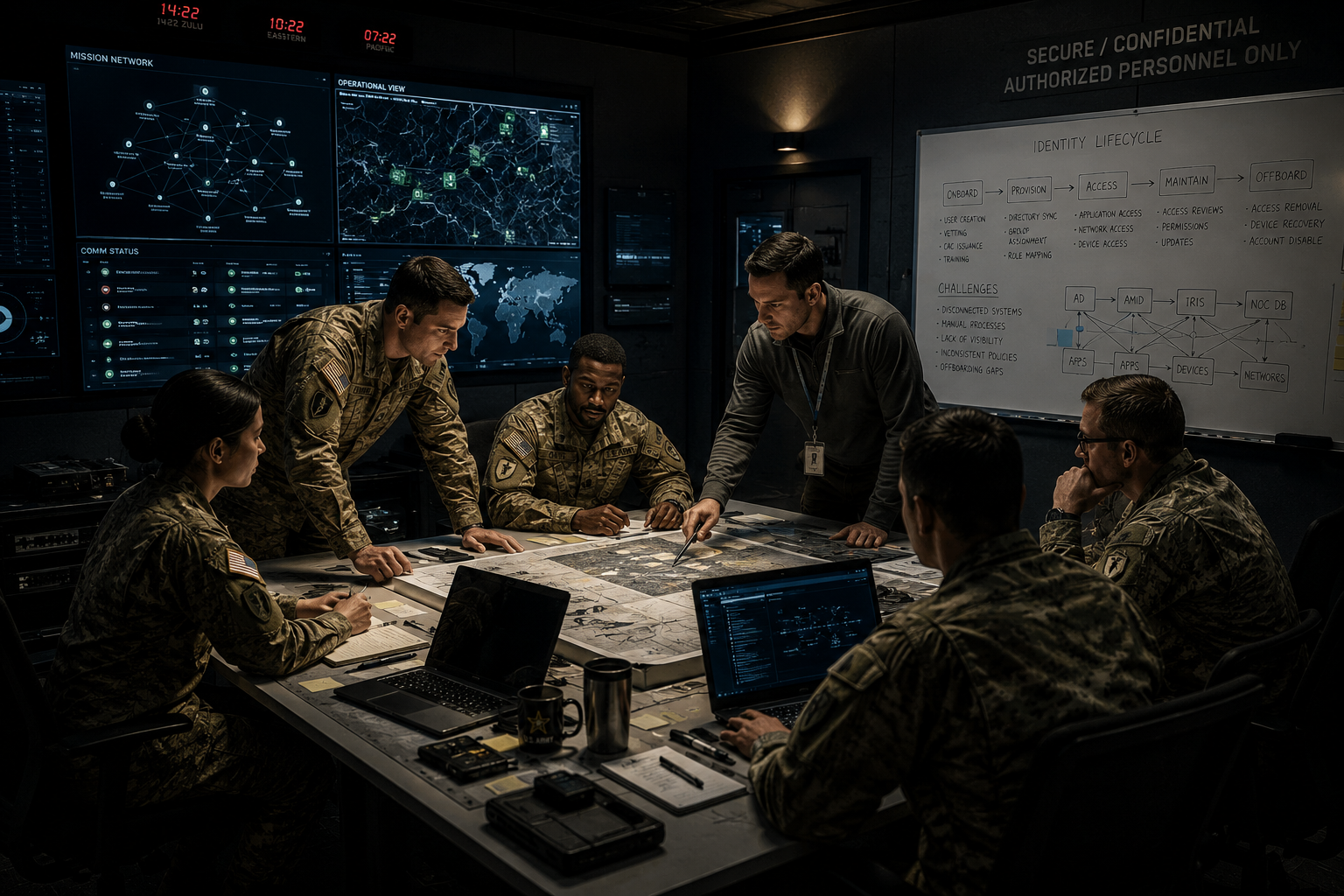
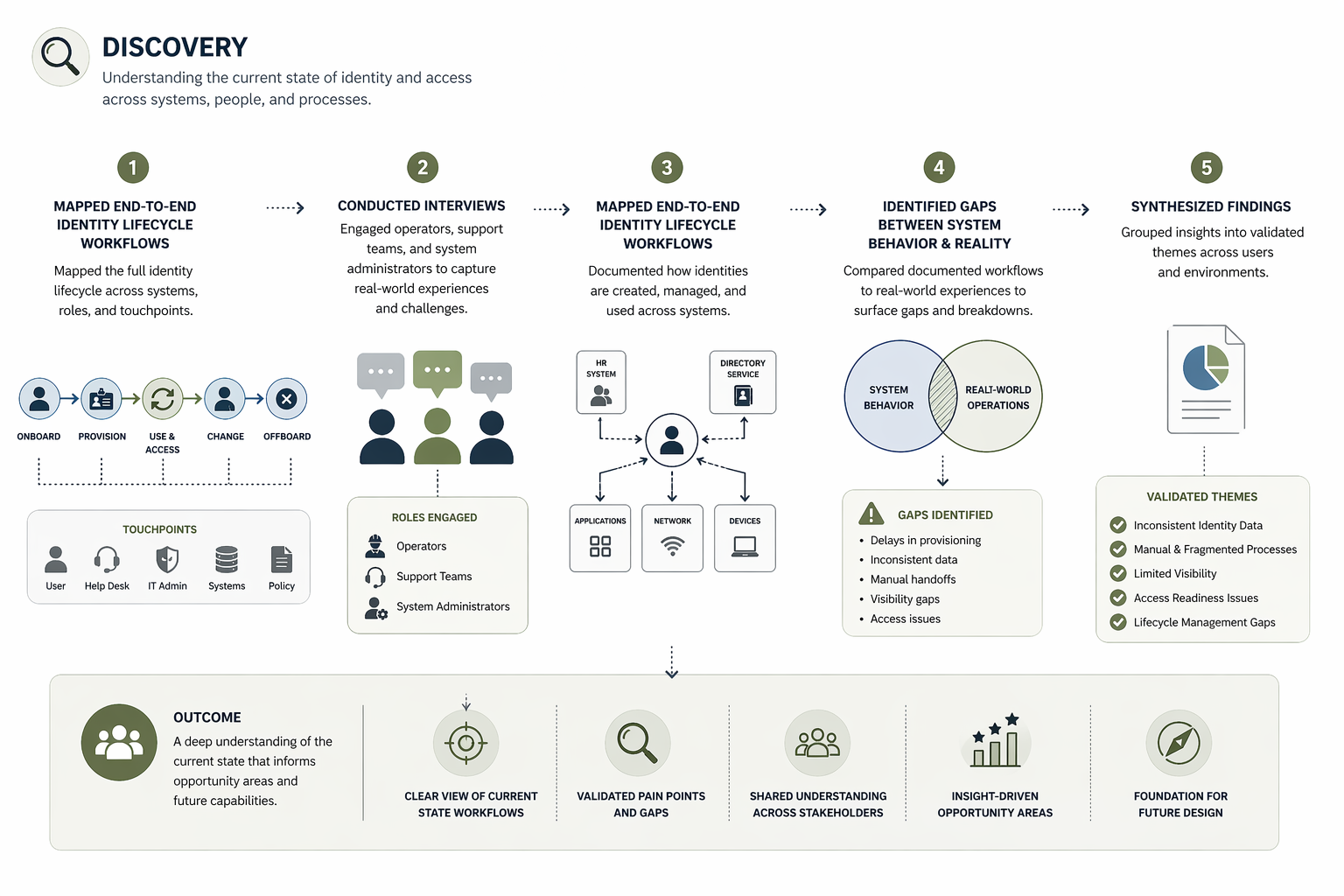
We met with Army operators, system administrators, support teams, and technical leaders to map the complete identity lifecycle, from onboarding through off boarding. Each conversation uncovered another piece of a much larger system, revealing how people, processes, and technologies intersected to support mission readiness.
As workflows were mapped, patterns began to emerge. Teams were often solving the same problems in different ways, relying on manual coordination, institutional knowledge, and disconnected systems to accomplish critical tasks.
Rather than validating assumptions, Discovery gave us a shared understanding of the current state and exposed the operational challenges that would shape every design decision moving forward.
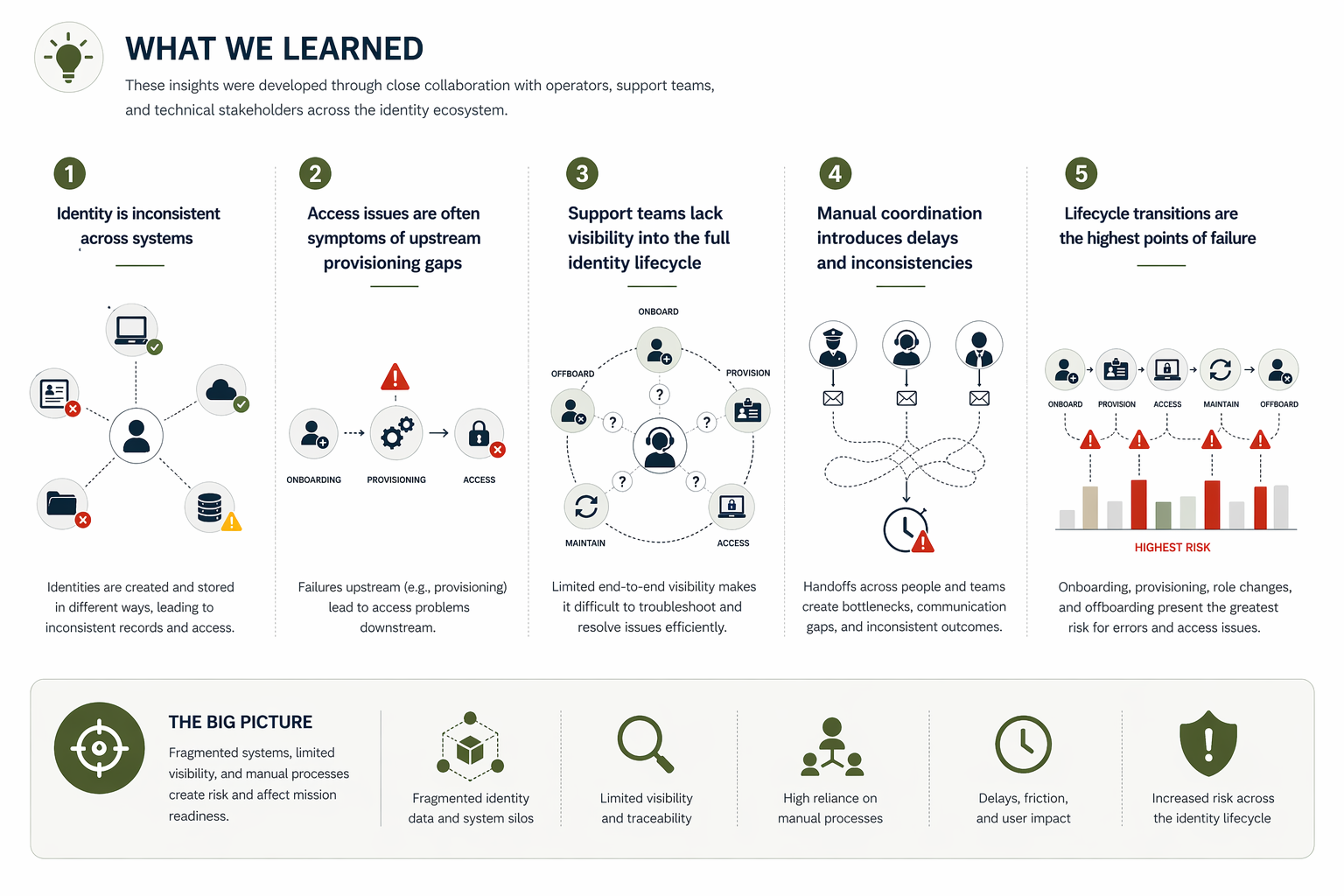
What We Learned
Patterns start to emerge.
The Discovery process uncovered recurring patterns across interviews, workflow analysis, and system documentation. Although each stakeholder experienced different parts of the identity lifecycle, the same operational challenges surfaced repeatedly.
Rather than isolated technical issues, we found systemic problems that affected visibility, coordination, and mission readiness across the entire identity ecosystem.
Framing
Turning insight into a shared strategy.
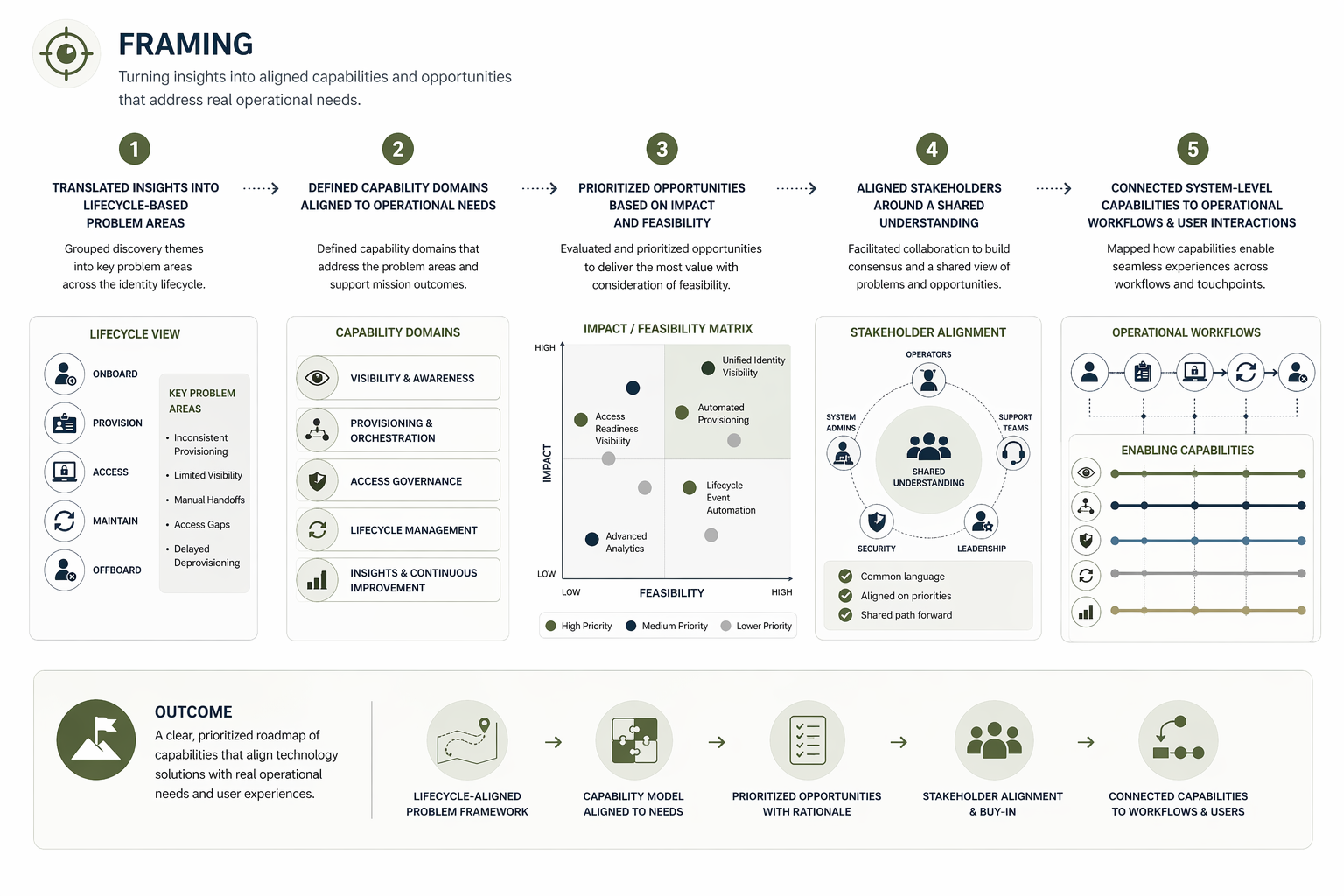
Discovery gave us hundreds of observations from interviews, workflow mapping, and operational analysis. The next step was to transform those individual findings into a framework that could guide future decision-making.
We grouped recurring themes across the identity lifecycle, identified common capability gaps, and evaluated opportunities based on operational impact and technical feasibility. This shifted the conversation away from isolated issues and toward the underlying capabilities needed to improve identity management across tactical environments.
Rather than designing features, we designed a shared understanding. The resulting capability model provided a common language for Army stakeholders, engineers, and leadership to prioritize investments and align future work around the same operational goals.
Identity Lifecycle
A new way of understanding identity management.
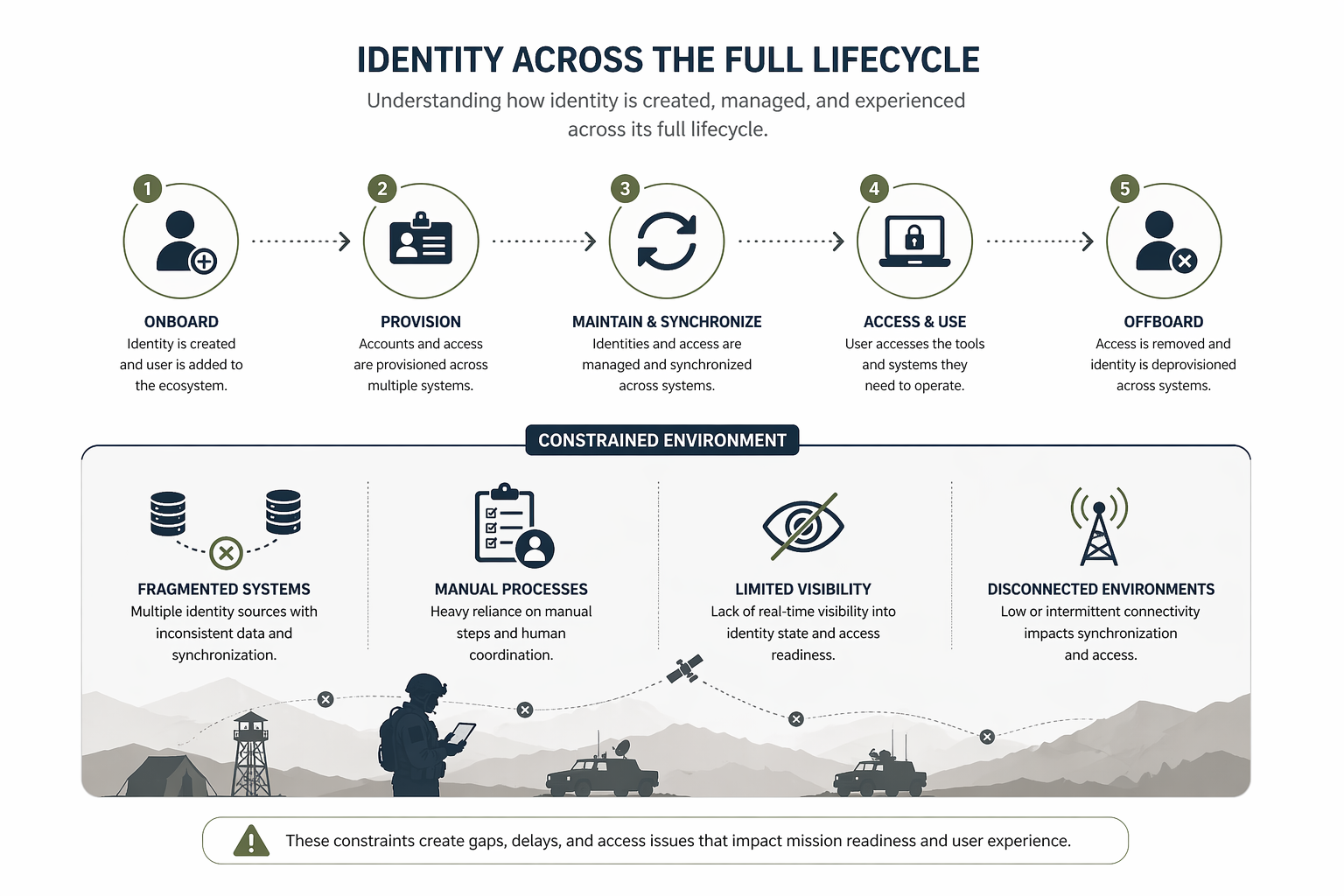
As research progressed, a clear pattern emerged:
Identity problems were rarely isolated to a single system or task. Most access issues could be traced back to earlier decisions made during onboarding, provisioning, or account management.
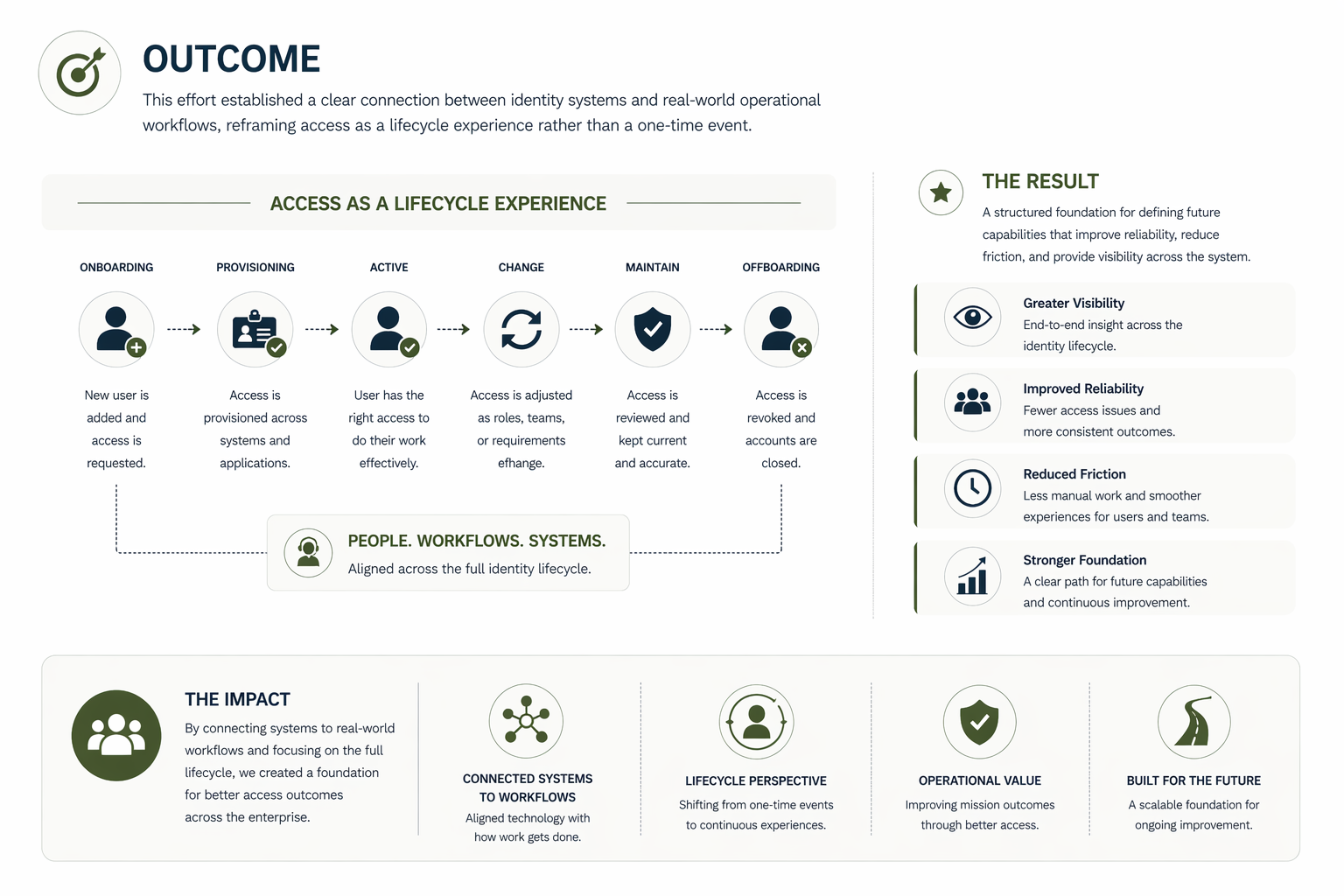
Instead of viewing identity as a one-time event, we reframed it as a continuous lifecycle that spans onboarding, provisioning, access, maintenance, and off boarding. Every stage depends on the accuracy and consistency of the one before it.
This lifecycle perspective exposed how fragmented systems, manual coordination, and disconnected environments introduced risk throughout the entire experience, not just at login. It also provided a shared mental model that helped stakeholders understand where improvements would have the greatest operational impact.
Viewing identity as a connected lifecycle revealed how decisions made at one stage influenced every stage that followed, creating a foundation for designing more resilient and scalable identity services.
Capability Framework
Defining what the future solution needed to enable.
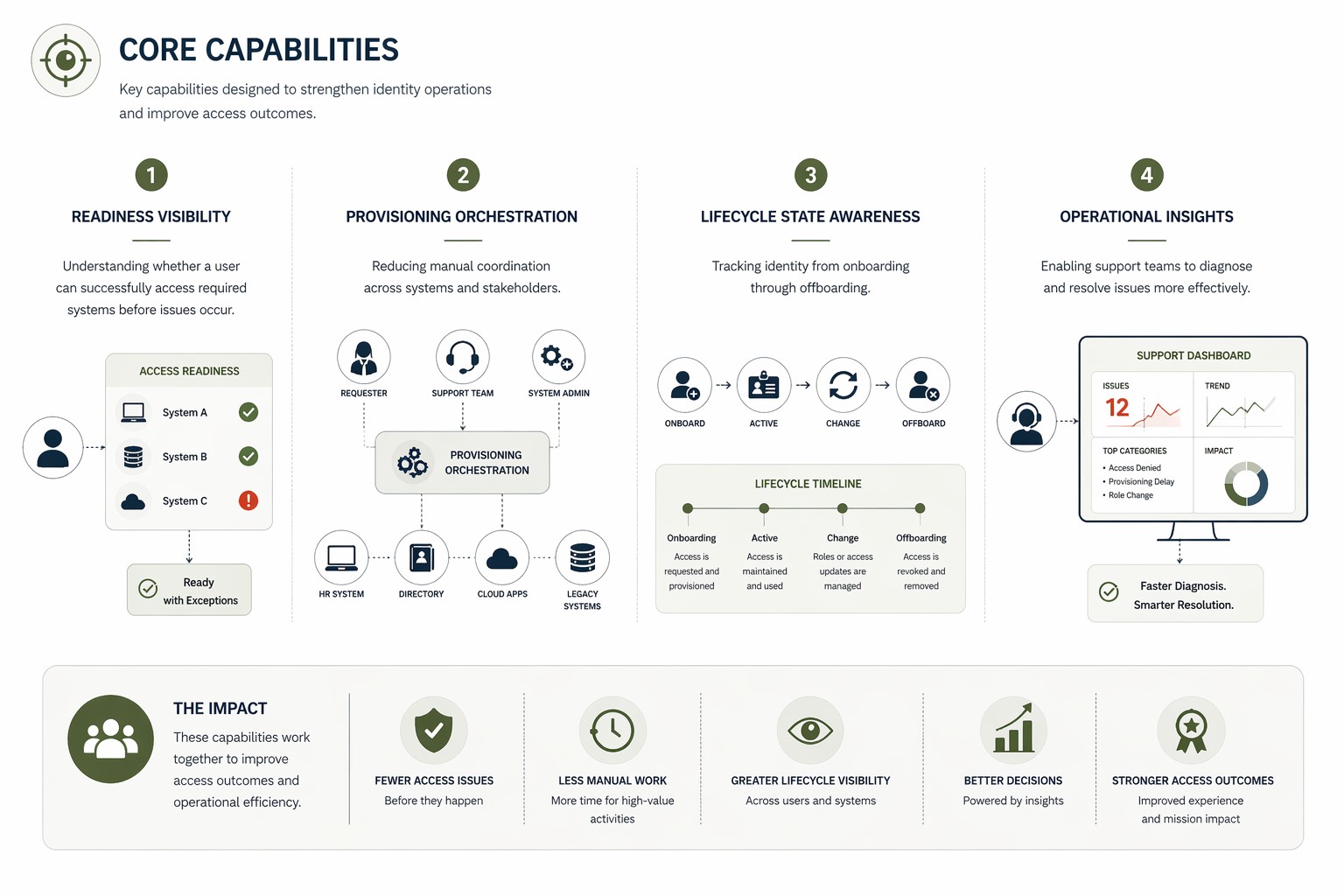
Discovery and Framing revealed that improving identity management wasn’t about replacing a single application. It required a coordinated set of capabilities that could support the entire identity lifecycle while reducing operational complexity.
Rather than designing isolated features, we identified the core capabilities that would address recurring challenges across onboarding, provisioning, lifecycle management, and operational support. Each capability was grounded in validated research and aligned to real operational needs.
Together, these capabilities established a strategic foundation for future product planning, helping stakeholders prioritize investments that would improve visibility, reduce manual effort, and create a more resilient identity ecosystem.
The capability model translated research into a practical roadmap, defining the foundational services needed to improve identity operations across people, processes, and systems.
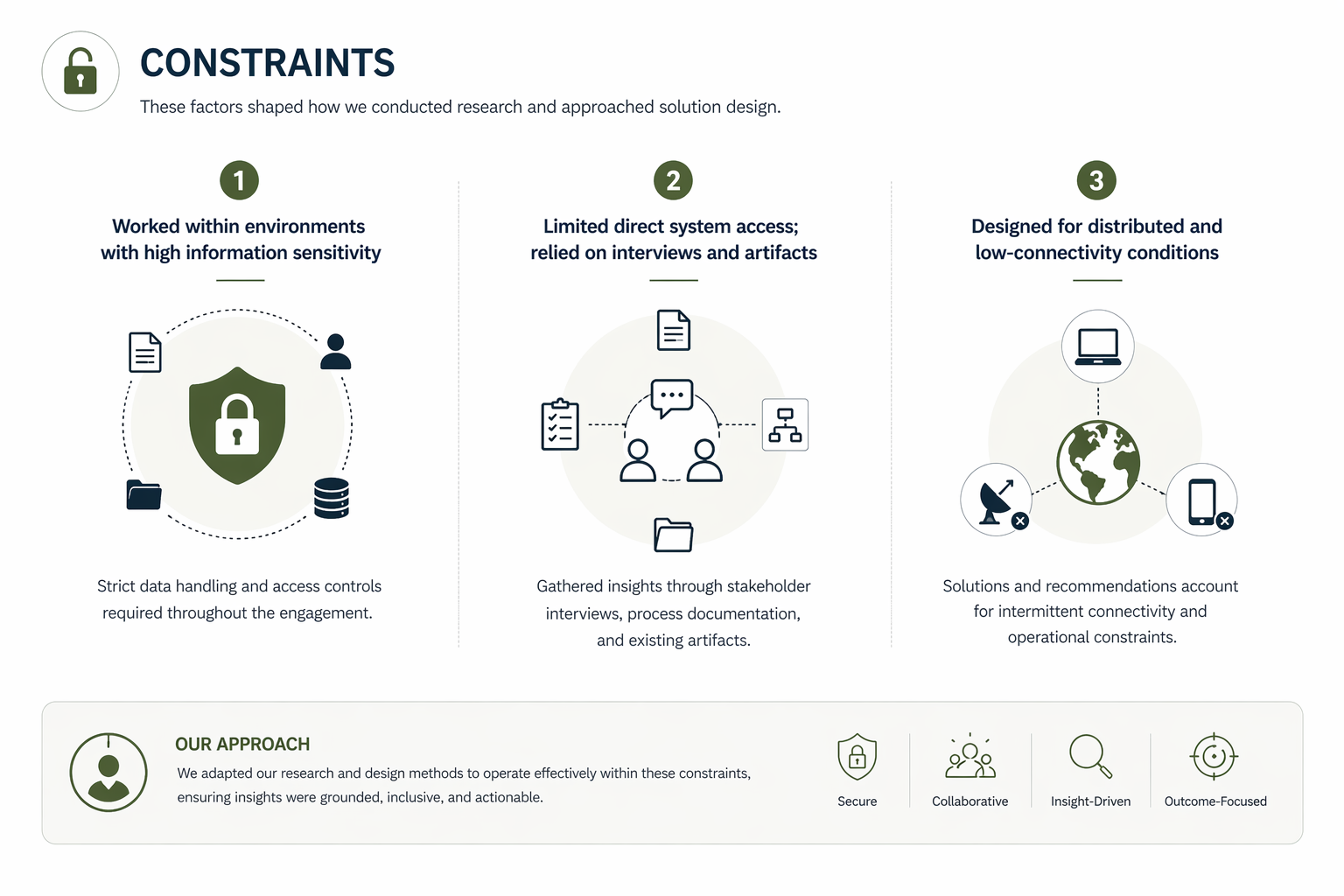
Constraints
What this project reinforced.
TICAM reinforced that the most valuable design work often happens long before a screen is created.
The biggest challenge wasn’t designing a better interfaceit was helping stakeholders develop a shared understanding of a complex operational ecosystem. By listening to people across different roles, mapping their workflows, and synthesizing hundreds of observations, we uncovered patterns that no single team could see on its own.
The experience also strengthened my appreciation for service design as a strategic discipline. When people, processes, and technology are viewed together rather than in isolation, opportunities emerge that extend far beyond individual features or applications.
This project reminded me that the role of a designer isn’t always to create the solution. Sometimes the greatest value comes from creating the clarity that allows the right solution to emerge.
Outcome
Creating a foundation for future capabilities.
By the end of the engagement, the team had transformed a collection of interviews, operational observations, and disconnected workflows into a shared understanding of tactical identity management.
The discovery, framing, and service design artifacts provided stakeholders with a common language for discussing identity challenges, evaluating opportunities, and prioritizing future investments. Rather than relying on assumptions or isolated perspectives, decisions could now be grounded in validated research and a holistic view of the identity lifecycle.
Although the project was not focused on delivering a production application, it established the strategic direction for future capabilities. The work aligned technical teams, product leadership, and Army stakeholders around a common vision for improving identity management across tactical environments.
The outcome was more than a collection of research artifacts. It was a strategic framework that enabled future planning, aligned stakeholders, and established a shared vision for modernizing tactical identity management.
Reflection
What this project reinforced.
TICAM reinforced that the most valuable design work often happens long before a screen is created.
The biggest challenge wasn’t designing a better interface, it was helping stakeholders develop a shared understanding of a complex operational ecosystem. By listening to people across different roles, mapping their workflows, and synthesizing hundreds of observations, we uncovered patterns that no single team could see on its own.
The experience also strengthened my appreciation for service design as a strategic discipline. When people, processes, and technology are viewed together rather than in isolation, opportunities emerge that extend far beyond individual features or applications.
This project reminded me that the role of a designer isn’t always to create the solution. Sometimes the greatest value comes from creating the clarity that allows the right solution to emerge.
Success wasn’t measured by the number of screens we designed. It was measured by how clearly we helped others understand the problem before deciding how to solve it.
Have a complex problem to solve?
I’m always interested in thoughtful conversations about product design, service design, enterprise systems, and human-centered AI.